




| Return to Andalucia Recently
I swapped sexy, sophisticated San Francisco for a remote Andalucian hamlet. Rather
than power walking around Stow Lake in Golden Gate Park every morning, I now amble
down chestnut and olive covered mountain slopes, seldom encountering another human
being. It is what you might call a far cry. This dramatic lifestyle change
came about partly because of nine-eleven. I didn't exactly flee the States but
one-way flights to Europe were irresistibly cheap and the untroubled Spanish mountains
were beckoning. I had lived on the Costa del Sol long ago so it felt like going
home. America had been fun, but a tad too competitive for me. It was dispiriting
awakening every morning to the realization that I would never make a good corporate
cog. And I never learned to shop. After twelve years in the New World it was time
to return to the Old. Apart from the bargain flights, I had a dream to follow
that had been gestating for a couple of years. A vision of a place in Andalucia,
Spain's southerlymost province - I am still searching for the word to describe
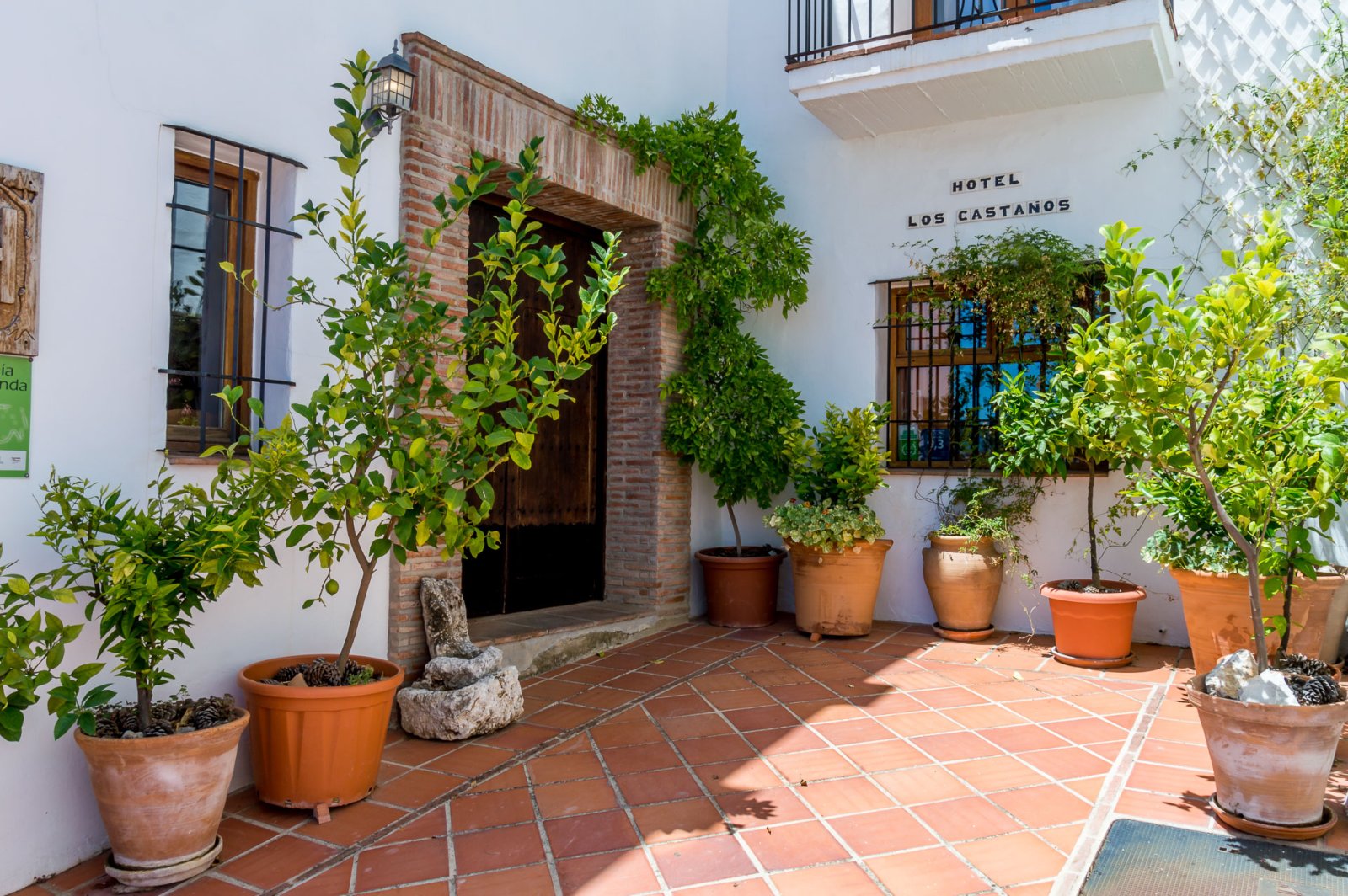
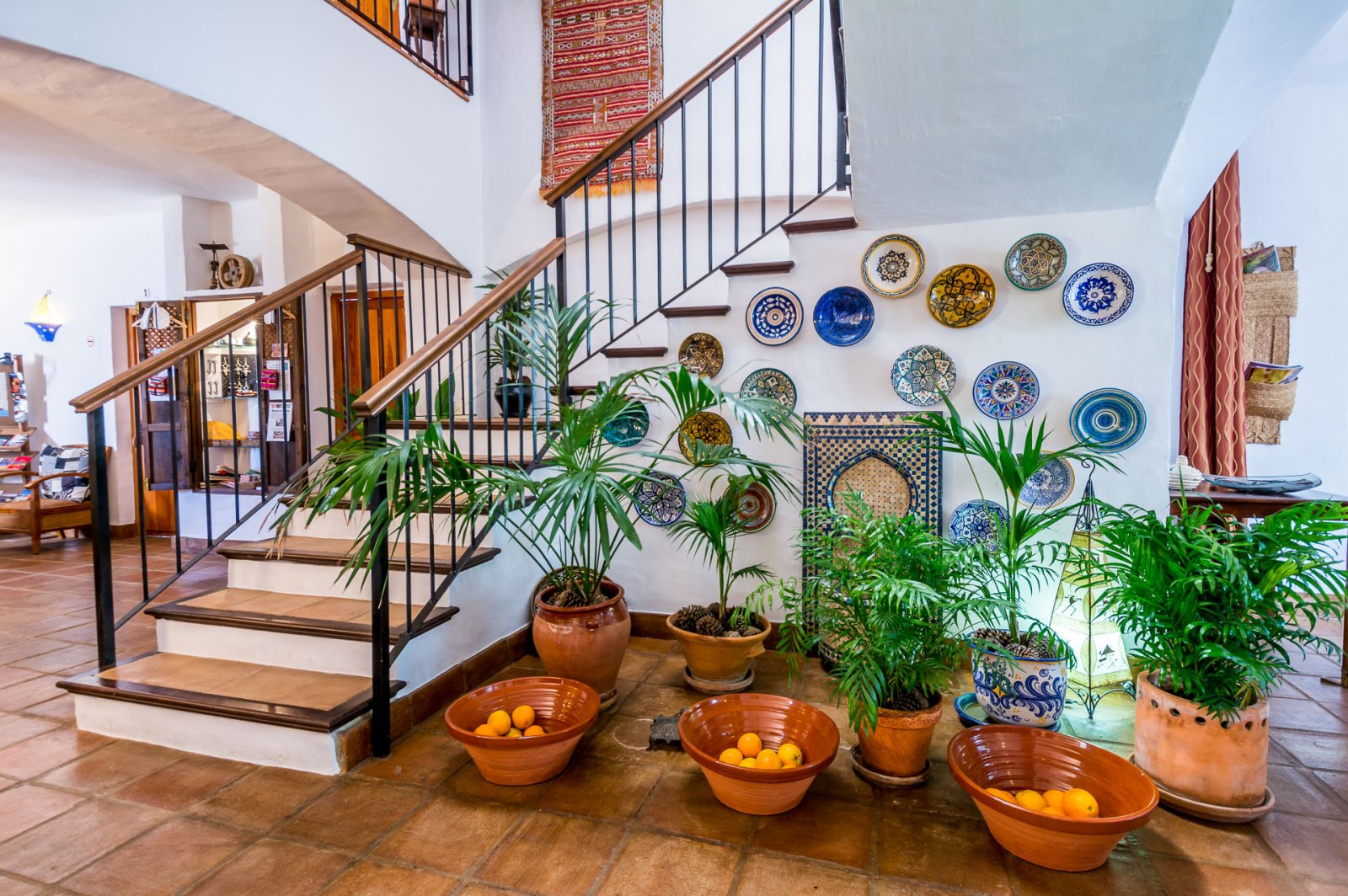
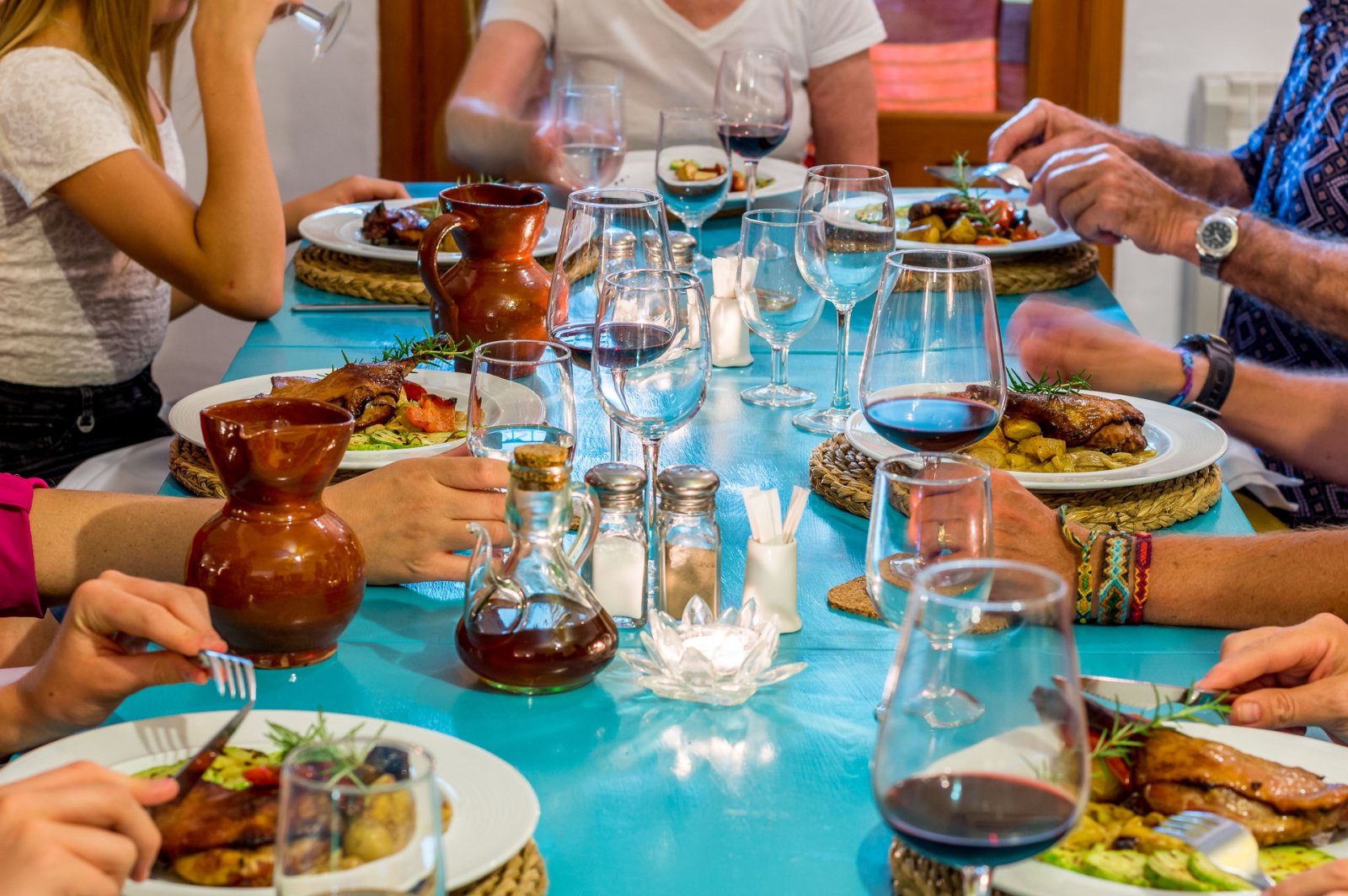
a 5-bedroom family-run hotel that offers elegant comfort and delicious dinner-party
style meals, personal tours of historical sites and insights into traditional
Andalucian culture and much more. A place where people will come to vacation and
see how pleasantly less stressful the simpler life is. If a suitably descriptive
word occurs to you, please contact me! (dibeach@loscastanos.com) The perfect
location awaited us; we (my daughter, her 5-year old son, and I) simply had to
find it. Our first criterion was it must be affordable; much of the southern Spain,
particularly near the coasts, is as expensive as San Francisco and we don't have
that sort of money as mentioned above. The second was that the property should
be near one of the pueblos blancos, the ancient white villages of Andalucia that
reflect Moorish architecture and lifestyle with their high-density living and
narrow alleyways. Thirdly, a largish town should be within easy reach. Lastly,
and most importantly, the village had to be Spanish and not foreign-dominated.
Our anticipated guests expected real Spain, not a watered-down parody. Hours
spent Googling had revealed, I thought, my future home before leaving the States.
Genalguacil was a village behind Estepona, close to the coast and the airport,
which seemed at first glance highly desirable. We visited it at lunchtime one
weekday but found no sign of life - nobody in the streets, no children playing,
just the odd mongrel asleep in the sun. The local venta (country restaurants located
on the edge of towns) was empty. This was a bad sign. You can walk into any venta
in Spain at 2 pm and find the place teeming with workmen enjoying their standard
3-course lunch with wine. This is one of the really civilized aspects of this
wild, anarchistic land. We returned to the village a second time, at the hour
of the evening paseo or stroll when most Spanish towns are bustling with their
residents dressed in their best, but found it still abandoned. The narrow white
streets were silent and, when we shushed Eli for raising his voice slightly, we
realized we were in the wrong place. This is not what Spain is about - children
are accepted as part of life and are never shushed. There was a lot of
art in this village though which was intriguing. On every corner a statue or sculpture,
on every wall a mural. We learned that the art was a scheme dreamed up by the
village authorities in an effort to promote the town which, like the other white
villages, was in danger of becoming a ghost town. Life has never been easy in
this part of Andalucia and people have usually had to seek work elsewhere, usually
in France or Morocco. The source of lucrative employment is closer now, on the
coast, so young people leave and only the older people remain in the villages.
The government is providing some incentives but the only sustainable solution
is a responsible tourist industry. In this particular village somebody had the
bright idea of an art festival every other year. Artists come from all over the
world (once from Mexico, they proudly told us), work on a piece for four days,
and then donate it to the town. It was innovative and lent a certain charm but
sadly we left the town realizing that it was not the paradise we sought. We heard
afterwards that foreigners were not particularly welcome so it was as well we
turned our attentions elsewhere. We wandered Andalucia getting ever further
away from the coast and the inflation. But the prices followed us. Simple country
people knew enough about the real estate market to add a few million pesetas to
their price. It was discouraging and yet we could not blame them. On one excursion
to a town far north of the coast we were offered a piece of land covered with
olive trees for a considerable sum which was reduced to nothing if I would simply
marry the owner. The whole mountainside would be mine, he insisted, gripping my
arm. A slightly embarrassing situation turned into a joke when, later in the day,
we saw the same gentleman with his wife. Our first few excursions into
distant areas were fruitless. It is hard to know what is for sale in an area where
real estate agents and their For Sale signs don't exist. The occasional hand-written
"Se Vende" was the most one could hope for. Instead of real estate agents, most
largish Spanish towns have a self-appointed "corredor" literally a runner, who
acts as a broker but the villages we discovered were too remote or too small to
warrant one. In time we learned that it was not rude to knock on a door and ask
the residents if their house was for sale. If it was not, which was usually the
case, the man of the house invariably escorted us on a wild-property chase around
the countryside. One time after walking for an hour away from the settlement we
found ourselves alone on a deserted hillside with two men with shotguns. My daughter
was quite rightly nervous. But all they wanted was to sell their barren land at
an inflated price to ignorant foreigners. In a town further south we thought
we had found our goal. Jimera de Libar nestled seductively in a wooded valley,
through which the railway from Algeciras to Ronda ran, stopping at a series of
quaint little stations. There was a delightful restaurant at the station where
we inquired of the lady owner about available property. The information that the
town had a mayoress rather than a mayor was exciting. A little wary after encountering
anti-foreigner sentiments elsewhere, we decided to call on the honorable lady
and present our idea. Nervously we rang the ayuntamiento (town hall) to make an
appointment, researched the correct way to address her, "Señora Doña Ana", and
prepared a written description of our planned cultural retreat which included
the benefits to the village. Attired formally in suits and heels, our relief was
unbounded when the lady mayoress entered her chambers dressed in jeans, a baggy
sweater, and a warm smile. After reading our proposal she commented that what
interested her most was Eli, the "niño de cinco años" who we had suggested could
play football for the town. A young mother, she had a personal as well as a civic
interest in repopulating the town. But this paradise turned into a nightmare
when we dug a little deeper and found that a rather undesirable and non-Spanish
element was trying to monopolize the real estate market. They were creating a
lucrative business for themselves by selling only to foreignors and at ludicrous
prices. Some of the villagers whom we asked about the situation confessed that
they did not care for the people involved but, they shrugged, what could they
do when offered such high prices. Real estate within reach of the coast has become
a hot item as people from northern Europe flock to find their place in the sun
and the business has attracted many unscrupulous rogues. I later met an English
family from London's East End who moved to Spain with the intention of opening
a furniture shop. When they saw the state of the property market, however, they
eagerly switched to real estate. Even though they had no experience and didn't
speak Spanish, they were making a fortune only a few months after opening their
doors. We were on the point of turning our sights reluctantly further west
to the Costa de la Luz. Reluctantly, as our network of friends and contacts was
on the Costa del Sol. One evening as we poring over the now rather tattered map
of Andalucia planning our next foray, we noticed an area that we had hitherto
overlooked. It was a cluster of tiny villages off the tourist trail but within
reach of the coast. The Arabic sounding names were vaguely familiar. They were
the seven villages of the Alto Genal. On a miserable February day we drove
yet again to the mountains, up the winding road north from San Pedro de Alcantara.
Turning off some ten kilometers before Ronda, the scenically spectacular Roman
and Phoenician town, we ventured the even narrower and more tortuous road to the
first two of the seven villages: Igualeja and Pujerra. Old hands now and our property-seeking
strategy well honed, we stopped a woman in the street and asked if there was much
for sale. She shrugged. Over there, she said, is where you must look. Following
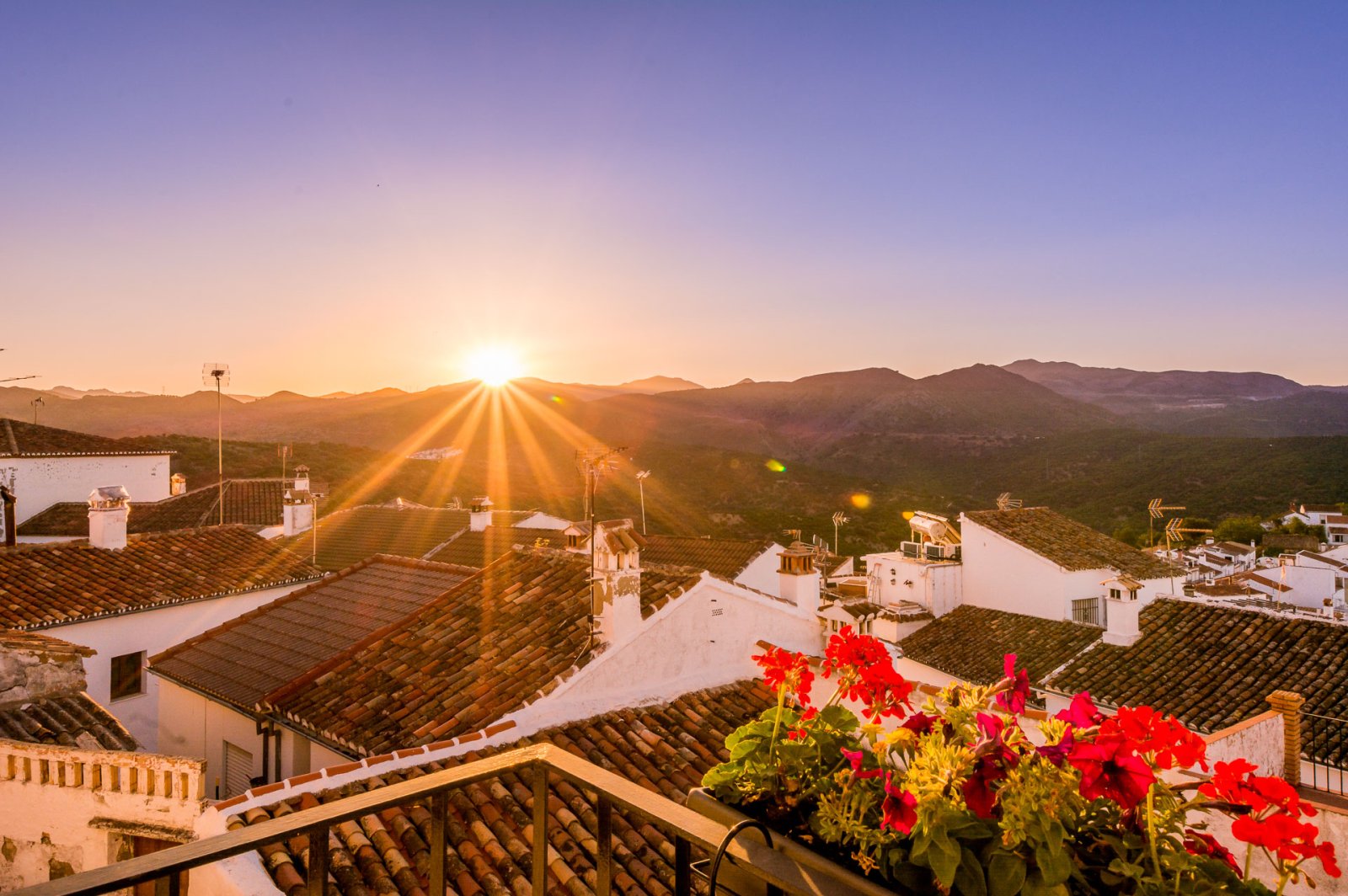
her finger pointing across the valley, we looked over to a village in the distance
reclining like a sleeping cat along a mountain ridge. White houses were glittering
in sunlight that had not yet reached the north-facing slope where we stood. We
retraced our steps back to the main road and across to the south-facing slopes
and the remaining five villages that adorn the mountain like a string of wide-set
pearls. The little village of Cartajima was six kilometers along a mountain
road in the middle of the Serranía de Ronda, a remote area long famous as a hideout
for banditos. To one side rugged rocks rose to heights of 1500 meters, to the
other the mountain was covered with chestnut and olive trees. It has always been
inaccessible which accounts no doubt for the fact that it is still charming and
unspoiled, everything we had been seeking. In the plaza we met Catalina, an black-garbed
elderly lady who greeted us openly and hospitably. Her son delivers the mail every
day and a more erudite man one could not wish to meet. This was an excellent start.
As we walked around chatting to people and looking at property, we knew
that the village met all our requirements. Property was still eminently affordable
although I am sure the prices we ended up paying were extortionate by village
standards. Not only was the property we bought within walking distance of a pueblo
blanco but it was in the very heart of one. I had never dared hope for this. Our
house is located in the square by the ayuntamiento (town hall) and the church,
the estanco where they sell candy and tobacco and the facsimile post office, virtually
a man and a rusty mailbox attached to a wall. The fleshpots of Ronda are only
ten kilometers away: ruined Arab baths, Islamic minaret, restaurants, and convents
selling dulces, sweets. These convents are closed Carmelite orders of Descalzas
(barefoot) nuns to which wealthy noblewomen were sent during the years after the
Reconquist in 1492. Their money enriched the convent and they made cakes to send
home to their families. As Spain declined, so did the convents and the nuns were
reduced to poverty. During the nineteen-fifties they were given a dispensation
to sell their dulces to the public as long as they remained hidden. The solution
to this problem is a revolving shelf, torno, in the small room set aside for these
transactions. One chooses ones dulces from a posted pricelist and rings the bell
to summon a nun. Tell her what you want, put the money in the revolving door,
and the cakes appear. Most importantly, Cartajima is a Spanish village
full of 200 Spanish people all of whom are to a greater or lesser degree related
to each other. We had a party over Christmas and invited our Spanish village friends
as well as our English and American friends. Several of the villagers asked who
these people were. Were they family? If not, how did we know them? Their society
is tight and closed and most people seldom leave the village except for shopping
trips to nearby Ronda. Some not even that. While the surrounding landscape is
forbidding and challenging, the people are friendly and benign and their only
fear for us is that we are not contentos. "Estais contentos?" they asked us for
the first six months we were living amongst them. Are you happy here? We hasten
to reassure them that we are all exceedingly contento and especially the five-year
old. Does he like the school? They ask. He loves the school. He has never been
happier. He races off every morning to find the other eight children and together
they go the few meters to the schoolhouse at the end of the village. His education
is tailored to his needs and he is allowed to progress at his own speed. Although
this is a passionately Catholic country, the study of religion is optional. As
he already knew more arithmetic than the curriculum required for this year, the
teacher has brought in more books to keep him engaged. A second language is introduced
at age 8. Peripatetic teachers of English, music, physical education, and religion
come twice a week to each of the seven villages that make up the Alto Genal. Idyllic
really. There is a bakery that produces bread in a wood-fired oven and
a little store that sells a few essentials at relatively high cost. The bank opens
for a few hours every morning. There is a pharmacy in Ana's front room. Knock
on the door if it isn't open. If what you want is not in stock, she will order
it and it arrives within twenty-four hours. The doctor comes four mornings a week
from Ronda and I was waiting for a trivial complaint to arise with which to test
his expertise. The necessity for syringing an ear before a long-haul flight provided
the perfect opportunity. I sat in the bare consulting area with the old women
who were delighted to have a chance to quiz their new neighbor, "la inglesa".
When it was my turn the doctor gave me some drops and told me to come back in
a few days and to bring a large bottle of warm water and a towel. Que? I asked
in surprise. We only have cold water in this office, was his explanation. Incidents
like this aside, it is staggering the progress that Spain has made in the intervening
years since I lived here in the seventies and even more amazing to consider the
state of the nation at the end of the Civil War in 1939. People were so poor,
particularly in Andalucia, that they were reduced to eating grass. The social
programs that exist now are as good as I have seen anywhere. The level of technology
is as advanced as the States or northern Europe. The infrastructure is for the
most part totally modern. And yet quality of life, often sacrificed for modernity,
remains intact. The Spanish people still value community more than goods. They
still go out of their way to help a stranger. Their fiesta days are numerous.
They still believe in mañana. It is indeed a far cry from San Francisco.
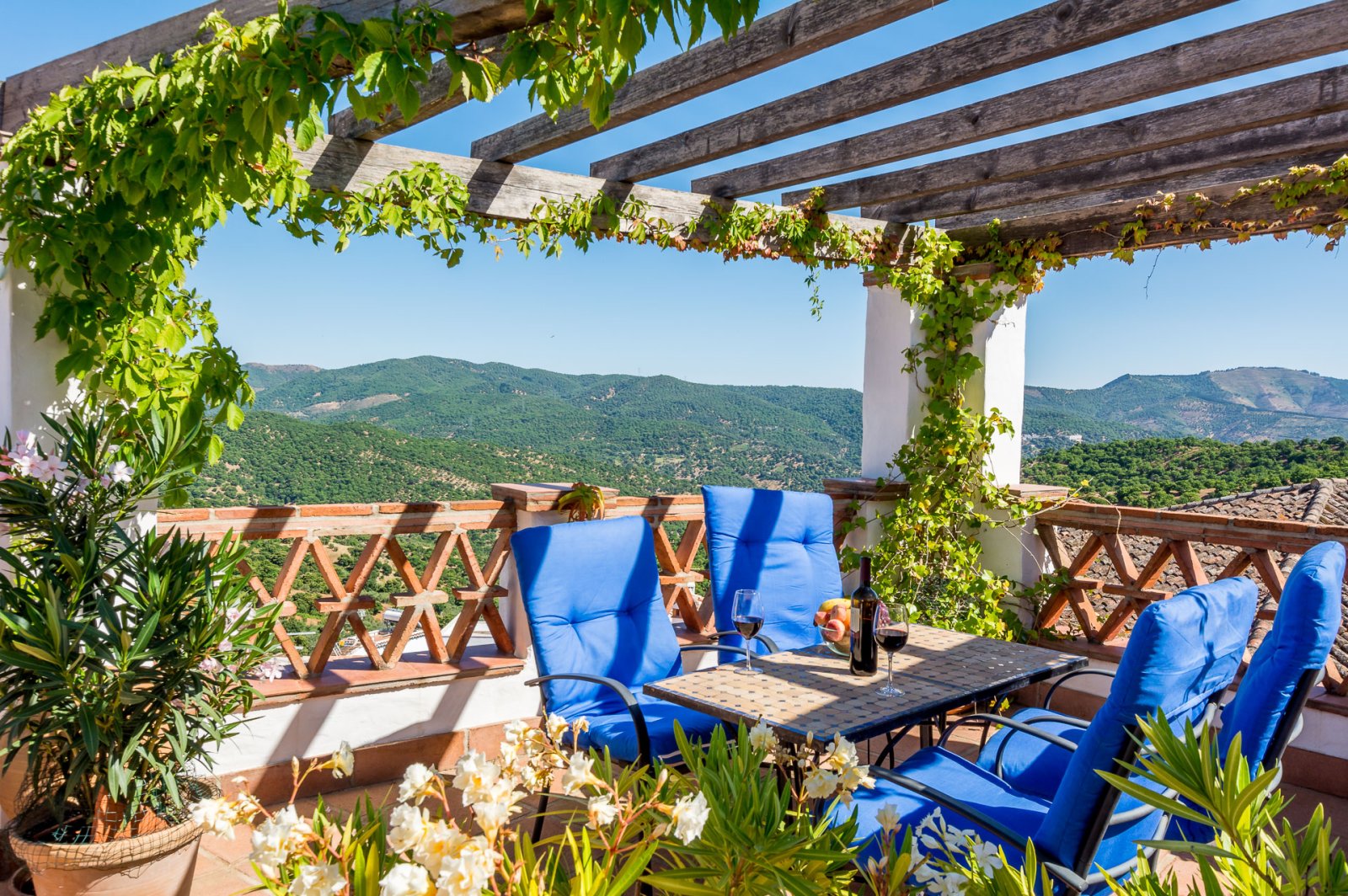
Except for the mist that sweeps in during the winter months totally obscuring
the spectacular panoramic views of the surrounding mountain range, Cartajima has
little in common with my erstwhile home. Do I miss the City? Yes, I miss the bookshops,
the restaurants, the views, and a few special people. Oh! And the sushi of course!
|